3D Printing Post-Processing and Finishing
Support and powder removal, bead blast, dyeing, vapor smoothing, and painting across SLA, SLS, MJF, FDM, and DMLS, and what each finish does to dimensional accuracy.
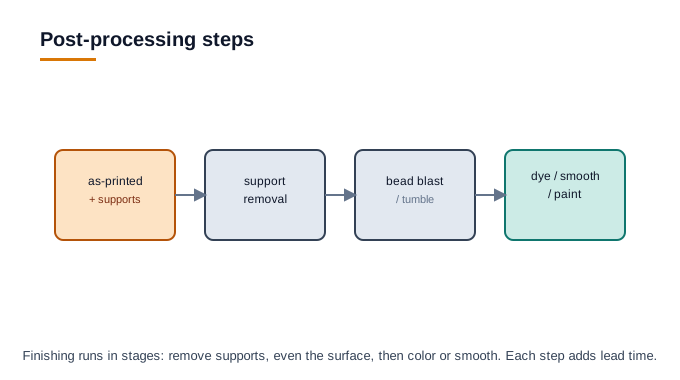
Download PDFA print comes off the machine usable but not finished. Every part needs cleanup first (support removal, powder removal, or washing and UV cure), then an optional cosmetic finish: bead blast, sanding, vapor smoothing, dyeing, or paint. Sanding, blasting, and smoothing move a little material, so machine any tight-tolerance feature after finishing rather than relying on the as-finished surface.
A part comes off a 3D printer usable but rarely finished. It carries support marks, a matte or stepped surface, and sometimes loose powder or uncured resin. Post-processing is what turns a raw print into a part that looks and performs the way you need. This guide covers the finishing options across the technologies we run and, just as important, what each does to accuracy.
The finishing steps below map to the additive standards (ISO/ASTM 52900) and to the finish options our DFM engine records per technology.
The baseline: cleanup
Every print needs cleanup before anything else:
- Support removal (SLA, FDM, metal). Supported surfaces leave witness marks where the supports attached; these are cleaned and sanded, but a faint mark can remain, so orient the part to keep supports off cosmetic or critical faces.
- Powder removal (SLS, MJF). Loose powder is blown and blasted out, which is why enclosed cavities need an escape hole.
- Washing and curing (SLA). Resin parts are washed of uncured resin and then UV-cured to reach full strength.
Smoothing and cosmetic finishes
Once clean, a part can be finished to a target look and feel:
| Finish | Process | Effect |
|---|---|---|
| Bead blast | Media blasted at the surface | Uniform matte, removes loose particles (standard on SLS and MJF) |
| Tumbling | Parts tumbled with media | Deburrs and evens edges on small parts |
| Sanding | Progressive abrasives | Removes layer lines on flat and gentle surfaces |
| Vapor smoothing | Controlled solvent vapor | Glossy, sealed surface on suitable polymers |
| Dyeing | Immersion dye (SLS, MJF nylon) | Uniform color, most commonly black |
| Painting, priming | Sprayed coats | Any color and a smooth cosmetic finish |
What finishing does to accuracy
Finishing is not free of dimensional effect, and this is the part designers most often miss:
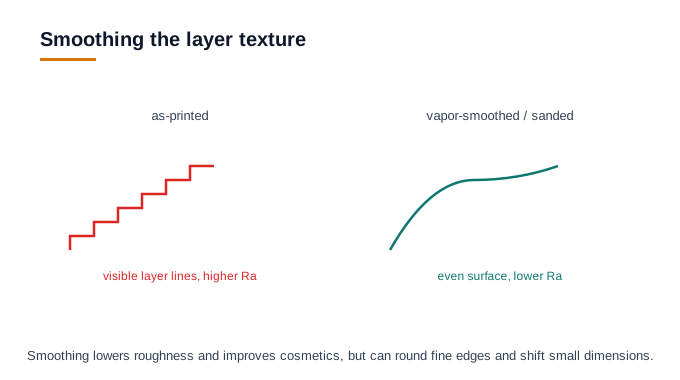
- Sanding, blasting, and vapor smoothing all remove or move a small amount of material, which can round sharp edges and shift a tight dimension by a few hundredths of a millimeter.
- Dyeing penetrates only the surface and does not change size.
- Painting and priming add thickness (typically tens of micrometers per coat), which matters on a close fit.
So specify a fine finish only on the faces that need it, and where a printed feature must hold a tight tolerance, plan to machine or ream it after finishing rather than relying on the as-finished surface.
Metal prints
Metal parts (DMLS) always need more than cleanup. They are cut from the build plate, stress-relieved, and then bead blasted or machined on functional faces. A metal print that needs a bearing fit, a sealing face, or a precise hole is machined after printing, exactly as a casting would be.
The checklist
Before you send a model to quote, confirm:
- The part oriented so supports fall off cosmetic and critical faces.
- Enclosed cavities given an escape hole for powder or resin.
- A finish specified only where the look or feel requires it.
- Tight-tolerance features planned for machining after finishing, not left as-finished.
- Paint or coating thickness accounted for on close fits.
How MASA FabWorks handles this
When you order a print, the finish you choose is recorded against the technology and applied after the baseline cleanup, and our DFM engine checks the finish against the process for compatibility. Where a feature needs a tolerance the printed-and-finished surface cannot hold, we flag it for a secondary machining step. The result is a part that looks right and still fits.
Frequently asked questions
- Does post-processing change a 3D-printed part's dimensions?
- Yes, some steps do. Sanding, bead blasting, and vapor smoothing remove or move a small amount of material and can round sharp edges; paint and primer add tens of micrometers per coat. Dyeing only penetrates the surface and does not change size. Machine tight features after finishing.
- What is vapor smoothing?
- Vapor smoothing exposes a part to a controlled solvent vapor that melts the outer layer slightly, leaving a glossy, sealed surface on suitable polymers. It removes layer lines but, like other smoothing steps, shifts tight dimensions slightly.
- How are metal (DMLS) prints finished?
- Metal prints are cut from the build plate, stress-relieved, then bead blasted or machined on functional faces. Any bearing fit, sealing face, or precise hole is machined after printing, exactly as a casting would be.
Related guides
Ready to check your own design? Upload your files. We measure your model against per-process, per-material rules and send a DFM review before you commit to a quote.