
Material Certifications and Compliance
RoHS, REACH, biocompatibility, material certificates, and the quality systems behind them: what you specify, what the facilities hold, and the documentation you receive.
Download PDFCompliance is a chain: you specify a requirement, the part is made under a quality system that controls it, and you receive documents that prove it. FabWorks holds no product certifications itself. Material rules like RoHS, REACH, and ISO 10993 biocompatibility are met by the material grade; the manufacturing facilities hold ISO 9001, IATF 16949, and ISO 13485.
Buyers in regulated markets, medical, automotive, and consumer electronics, often need more than a part that fits: they need proof of what it is made of and how it was made. Compliance is not a single certificate; it is a chain of requirements you specify, controls applied during manufacturing, and documentation you receive. This guide explains the common material and manufacturing compliance requirements and how to get them met.
MASA FabWorks does not hold product certifications itself. The requirements below are specified by you, met by the manufacturing facilities and the materials they use, and evidenced by documentation you receive.
The compliance chain
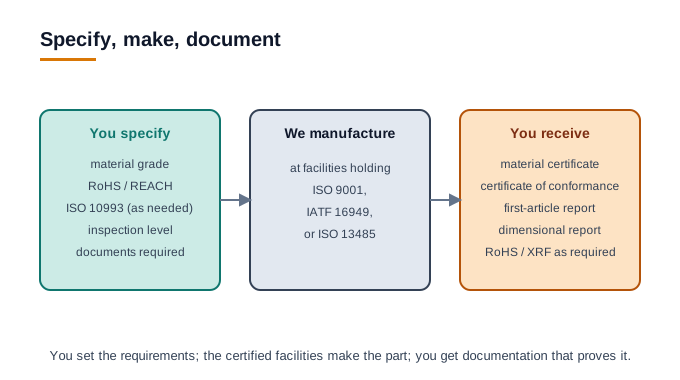
Compliance runs in three steps: you specify the requirement, the part is made under a quality system that controls it, and you receive documents that prove it. Tell us the requirements at quote time so they are planned into the job rather than added after.
Material compliance
- RoHS (Restriction of Hazardous Substances). The EU directive restricts lead, mercury, cadmium, hexavalent chromium, and certain flame retardants in electrical and electronic products. Specify RoHS and a compliant material is selected; composition can be verified by XRF and reported.
- REACH. The EU regulation governs the registration and restriction of chemical substances, including a list of substances of very high concern (SVHC). Specify REACH compliance and materials are chosen accordingly, with declarations available.
- Material certificates. A mill or material certificate documents the grade, composition, and mechanical properties of the stock used, with traceability back to the lot. Request it and it travels with the parts.
- Biocompatibility. For components with body contact, materials can be specified to meet ISO 10993 or USP Class VI. These are properties of the material grade you select: the part is made from a compliant grade and documented. (We do not manufacture implants or life-support devices.)
Manufacturing quality systems
The manufacturing facilities operate under recognized quality-management systems, held by the facility, not by FabWorks:
- ISO 9001 for general quality management.
- IATF 16949 for automotive production.
- ISO 13485 for medical device components.
These systems govern process control, traceability, and corrective action, which is what makes the documentation you receive meaningful.
The documentation you can receive
Depending on what you specify, a job can come with:
- A certificate of conformance (CoC) stating the parts meet the drawing and specification.
- A material certificate with grade, composition, and traceability.
- A first-article inspection report on the first parts off a new setup.
- A dimensional report against the drawing (see the metrology guide).
- A RoHS or XRF report where restricted-substance compliance is required.
Data and security compliance for the platform itself (how your files and data are handled) is provided by enterprise infrastructure, separate from the manufacturing certifications above.
The checklist
Before you send a part to quote, tell us:
- Any material compliance required (RoHS, REACH, biocompatibility grade).
- The quality system the part must be made under, if it is regulated.
- The documents you need delivered (CoC, material certificate, first-article, dimensional, RoHS).
- Any traceability requirement (lot, heat, or serial).
How MASA FabWorks handles this
When you specify a compliance requirement, it is carried into the job: a compliant material grade is selected, the part is made at a facility holding the right quality system, and the documents you asked for are produced and delivered with the parts. Nothing is claimed that is not substantiated, and the paperwork ties back to the same drawing and inspection the DFM engine and metrology cover. The result is a part you can put into a regulated product with the evidence to back it.
Frequently asked questions
- Is FabWorks ISO certified?
- FabWorks does not hold product certifications itself. The manufacturing facilities operate under recognized quality-management systems, held by the facility: ISO 9001 for general quality, IATF 16949 for automotive, and ISO 13485 for medical device components. Data and security compliance for the platform is provided by enterprise infrastructure.
- What is the difference between RoHS and REACH?
- RoHS is an EU directive restricting hazardous substances (lead, mercury, cadmium, and others) in electrical and electronic products; REACH is an EU regulation governing chemical substances more broadly, including a list of substances of very high concern. Specify either and a compliant material is selected and documented.
- What compliance documents can I receive?
- Depending on what you specify: a certificate of conformance, a material certificate with grade and traceability, a first-article inspection report, a dimensional report, and a RoHS or XRF report. Request them at quote time so they are planned into the job.
Related guides
Ready to check your own design? Upload your files. We measure your model against per-process, per-material rules and send a DFM review before you commit to a quote.