
Cross-Border Delivery and DDP: One Delivered Price
How a part made overseas reaches your dock, what DDP and DAP mean, and why FabWorks delivers one all-in price with freight, customs, and duties handled.
Download PDFA part made overseas passes through freight, insurance, export and import customs, and duties before it reaches you. Under DDP (Delivered Duty Paid) the seller clears customs and pays the import duties, so you receive the goods without dealing with the border and are not the importer of record. FabWorks quotes DDP by default for delivery in the United States, and DAP outside it, because only the importer of record can reclaim import VAT or GST.
When you buy a custom part made overseas, the price on the quote is rarely the price you actually pay. Between the manufacturing location and your dock sit freight, insurance, customs clearance, import duties, taxes, and a stack of paperwork, and any one of them can turn a good unit price into a delivery that is late, held at the border, or more expensive than you planned. This guide explains the delivered-price model in plain terms, so you can see what you are buying and what you are not.
Where a cross-border order actually spends its time
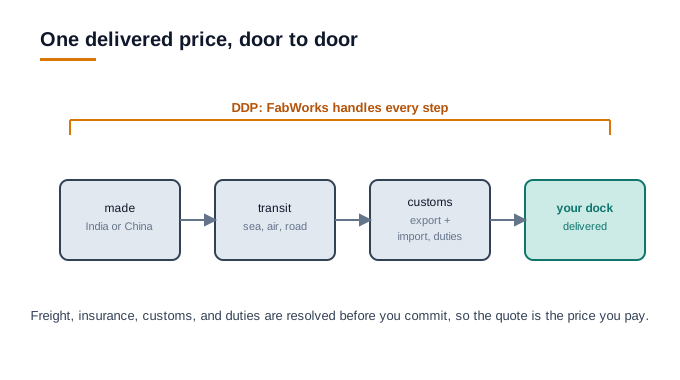
A part made abroad crosses several handoffs before it reaches you: it leaves the manufacturing location, moves by road, sea, or air, clears export from the origin country, clears import into the destination country, and is delivered to your address. Each handoff is a place where a shipment can wait, and each has its own document (a commercial invoice, a packing list, a certificate of origin, a customs entry) that has to be right for the goods to move. Managing that chain is a job in itself, separate from making the part well.
Incoterms in one paragraph
Incoterms are the internationally recognized rules, published by the International Chamber of Commerce, that define who is responsible for the goods at each point in the journey: who arranges transport, who carries the risk if something is damaged, and who handles export and import. Two matter most here:
- DDP (Delivered Duty Paid): the seller is responsible all the way to your door, including clearing customs and paying import duties and taxes. You receive the goods without dealing with the border.
- DAP (Delivered at Place): the seller delivers to your location, but you are the importer of record and handle the import clearance, duties, and taxes.
The difference is not cosmetic. It decides who deals with customs, who is exposed if a shipment is delayed or reassessed, and how predictable your final cost is.
The value proposition: one delivered price, hands off
For delivery inside the United States our default is DDP. We arrange the freight and customs clearance on both sides of the border, and the import duties and tariffs are included in your price, so you get a single delivered price and parts that arrive at your dock. You are not the importer of record: no customs broker account to open, no import entry to file, and no surprise duty bill weeks after delivery.
For delivery outside the United States our default is DAP, and the reason is tax recovery rather than convenience. Import VAT in the UK and the EU, and GST in Australia and New Zealand, can only be reclaimed by the party named as importer of record on the customs entry. Under DDP that party is not you, so a recoverable tax turns into an unrecoverable cost buried in the delivered price. In the EU there is a second constraint: the Union Customs Code requires the customs declarant to be established in the Union, so a US seller cannot act as importer of record there without appointing a local representative. Taking DAP keeps you on the entry, which is what lets a VAT-registered business reclaim the import VAT. Either term is available wherever you are, and the Incoterm on your quotation is the one that governs.
That model matters for three reasons:
- Predictability. You see one delivered price up front, with international freight, customs clearance, and import duties included, so you can plan and approve against a single number instead of piecing costs together after the fact.
- Simplicity. Cross-border logistics is specialized work. Folding it into the order means your team stays focused on the part and the program, not on tariff codes and carrier claims.
- One point of contact. If a shipment is delayed or held at customs, you have one partner coordinating the fix and keeping you posted, not a carrier and a broker in another time zone to chase. We manage the parties and the paperwork so a problem in transit is a call to us, not a project for your team.
What you should still tell us
A delivered price depends on a few things only you know: the destination, the quantity and schedule, and any industry or end-use requirements that affect how goods are classified or what documentation you need. Share those at quote time and the delivered price reflects your real situation rather than an assumption.
What this guide deliberately does not cover
This is an explainer, not a cost model. It does not tell you how a landed cost is calculated, what any duty or freight rate is, or how a delivered price is built up, because those depend on live, order-specific factors and are quoted per project. When you request a quote, you get a delivered price for your part, your quantity, and your destination, and you can decide with the full number in front of you.
Frequently asked questions
- What is the difference between DDP and DAP?
- Under DDP (Delivered Duty Paid) the seller is responsible all the way to your door, including clearing customs and paying import duties, so you are not the importer of record. Under DAP (Delivered at Place) the seller delivers to your location, but you are the importer of record and handle clearance and duties.
- Do I have to deal with customs and import duties?
- For delivery in the United States, no. FabWorks quotes DDP: freight, customs clearance on both sides of the border, and import duties and tariffs are included in one delivered price, with no customs broker account to open and no surprise duty bill after delivery. Outside the United States we quote DAP by default, because import VAT or GST can only be reclaimed by the importer of record, and under DDP that is not you. Either term is available wherever you are.
- What does one delivered price include?
- The DDP quote includes international freight, customs clearance, and import duties and tariffs to your dock, so you can plan against a single number. Destination sales, use, or VAT taxes remain yours. Share your destination, quantity, and any end-use requirements so the delivered price fits your situation.
Related guides
Ready to check your own design? Upload your files. We measure your model against per-process, per-material rules and send a DFM review before you commit to a quote.