
Materials Selection Reference: Alloys and Resins
The metal and plastic families we work in, the properties that separate them, and how to narrow from a family to a grade that both performs and manufactures cleanly.
Download PDFChoose a material from function to family, then grade. Aluminum and steel carry load; stainless and select plastics resist corrosion; aluminum, magnesium, and filled polymers save weight; copper alloys conduct. Free-machining grades (6061, brass C360, 303 stainless) cut fast and cost less, so a grade chosen for machinability can lower cost without changing function.
Material choice sets what a part can do and much of what it costs to make. A grade that is stiffer, tougher, or more corrosion-resistant than the job needs adds price and often machines or molds harder; one that falls short fails in service. This reference lays out the families we work in, the properties that separate them, and how to narrow from a family to a grade. The numbers are typical published values for screening, not lot-certified specifications.
Every property below comes from public sources: producer datasheets, the UNS and AISI/SAE designation systems, and standard references such as the ASM handbooks. Confirm the exact figure against the applicable specification for a given lot and temper before you commit a critical design.
Choosing a family
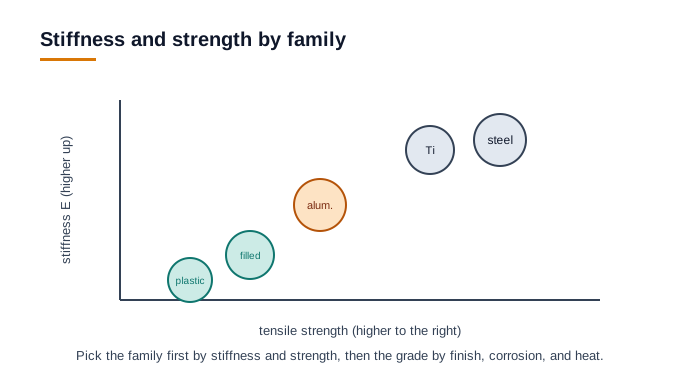
Work from function to family. Load-bearing metal parts start with aluminum or steel; corrosion or hygiene points to stainless or certain plastics; light weight favors aluminum, magnesium, or filled polymers; electrical or thermal conductivity points to copper alloys. Then pick the grade by the secondary needs: finish, temperature, wear, and cost.
Metals
| Family | Common grades | E (GPa) | Tensile (MPa) | Notes |
|---|---|---|---|---|
| Aluminum | 6061-T6, 7075-T6, 5052, 2024, 6063 | ~69 | 240 to 570 | Light, machines well; 7075 strongest, 5052 for sheet, 6061 the all-rounder |
| Carbon and alloy steel | 1018, 1045, 4140, 4340 | ~205 | 440 to 1280 | Strong and low-cost; 4140 and 4340 heat-treatable; rusts unless coated |
| Stainless steel | 303, 304, 316, 17-4 PH, 416, 430 | ~193 to 200 | 485 to 1310 | Corrosion-resistant; 316 for marine and chemical, 303 and 416 free-machining, 17-4 PH hardenable |
| Copper alloys | Brass C360, C260, bronze C932, beryllium copper | ~97 to 128 | 300 to 1400 | Conductive; C360 the free-machining benchmark, bronze for bearings |
| Titanium | Ti-6Al-4V | ~114 | 1170 | High strength-to-weight, corrosion-resistant, hard to machine |
| Magnesium, zinc (cast) | AZ91D, AM60B, Zamak 3, Zamak 5 | ~45, ~96 | 200 to 360 | Die-cast; magnesium lightest structural metal, zinc casts finest detail |
Machinability tracks with these families: free-machining grades (aluminum 6061, brass C360, stainless 303 and 416) cut fast and low-cost, while austenitic stainless (304, 316), titanium, and hardened tool steels cut slowly and cost more. A grade chosen for easy machining can lower part cost without changing function.
Plastics and resins
| Resin | Class | Character | Typical use |
|---|---|---|---|
| ABS | Amorphous | Tough, easy to mold and machine | Housings, consumer parts |
| Polycarbonate (PC) | Amorphous | Very tough, clear, higher heat | Guards, lenses, enclosures |
| Polypropylene (PP) | Semi-crystalline | Chemical-resistant, living hinges | Containers, hinged parts |
| Nylon (PA6, PA66) | Semi-crystalline | Strong, wear-resistant, absorbs moisture | Gears, bushings, brackets |
| POM (acetal) | Semi-crystalline | Stiff, low friction, best-machining plastic | Gears, precision parts |
| PEEK, PEI (Ultem) | High-performance | High heat and chemical resistance | Demanding thermal or chemical parts |
| Glass-filled grades | Filled | Much stiffer, less shrink, more abrasive | Structural molded parts |
Amorphous resins (ABS, PC, PEI) shrink little and hold tighter tolerances; semi-crystalline resins (PP, nylon, POM) are tougher and more chemical-resistant but shrink more, so their molded tolerances are looser. Glass fill raises stiffness and cuts shrinkage but warps anisotropically and wears tooling, so treat a filled grade as its own material, not a stiffer version of the base resin.
Matching material to process
Not every grade runs in every process. Wrought bar and plate machine; sheet grades bend; die casting uses specific aluminum, zinc, and magnesium alloys; injection molding uses molding grades, which differ from the machinable cast or extruded stock of the same polymer. When you pick a material in a quote, we confirm it against the chosen process so the grade is one the process actually runs.
How MASA FabWorks uses this
Our capability data ties each material to the processes that can run it and to the DFM thresholds, wall, radius, and tolerance, that depend on it, so when you choose a grade the engine checks your geometry against that grade rather than a generic default. Tell us the function, temperature, and environment and we will confirm a grade that both performs and manufactures cleanly.
Frequently asked questions
- What is the difference between 6061 and 7075 aluminum?
- 6061-T6 is the machinable, weldable all-rounder for general structural parts; 7075-T6 is significantly stronger (tensile up toward 570 MPa) for highly loaded parts, but it costs more and is harder to weld. Choose 7075 only where the extra strength is needed.
- Should I use 304 or 316 stainless steel?
- Both resist corrosion and machine slowly. Choose 316 for marine and chemical environments, where its added molybdenum improves resistance; 304 is the lower-cost default elsewhere. Where free machining matters, 303 cuts faster but trades some corrosion resistance.
- Which plastic machines best?
- POM (acetal) is the stiff, low-friction, best-machining plastic, ideal for gears and precision parts. ABS and polycarbonate machine well for housings, while nylon is strong and wear-resistant but absorbs moisture.
Related guides
Ready to check your own design? Upload your files. We measure your model against per-process, per-material rules and send a DFM review before you commit to a quote.