
Tolerance Stack-Up and Assembly
How tolerances accumulate across mating parts, worst-case vs statistical stacking, and how to design the chain down so assemblies go together the first time.
Download PDFIndividual parts can be in tolerance and an assembly still fail, because tolerances accumulate down a chain. Three parts each at +/- 0.10 mm (0.004 in) can sum to +/- 0.30 mm worst case, or about +/- 0.17 mm by the statistical (RSS) method. Design the stack down: reduce part count, share datums, and spend the tight band only where it drives the fit.
A part can be in tolerance and an assembly still fail. When several parts stack together, their individual tolerances add up, and the total variation at the end of the chain can be far larger than any single part's. Managing that accumulation, the tolerance stack-up, is what makes an assembly go together and work. This guide covers how stacks add and how to design them down.
The methods here build on the general tolerance and GD&T primer and follow ASME Y14.5 and ISO practice.
How a stack adds
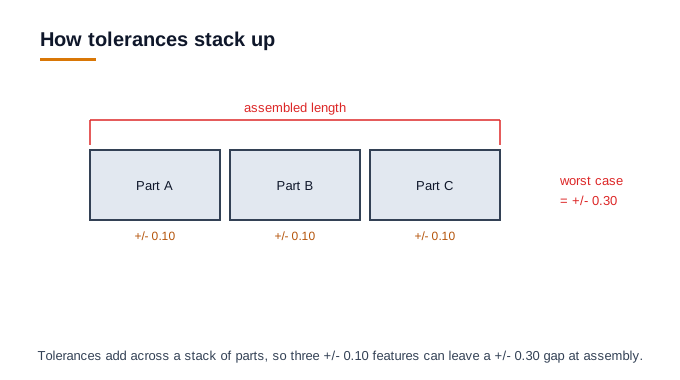
In the simplest chain, dimensions in a line, the tolerances add directly. Three parts each held to +/- 0.10 mm (0.004 in) can leave a gap that varies by +/- 0.30 mm (0.012 in) at assembly, because in the worst case every part sits at the same extreme. That worst-case sum is the conservative way to guarantee an assembly always fits.
Worst case vs statistical
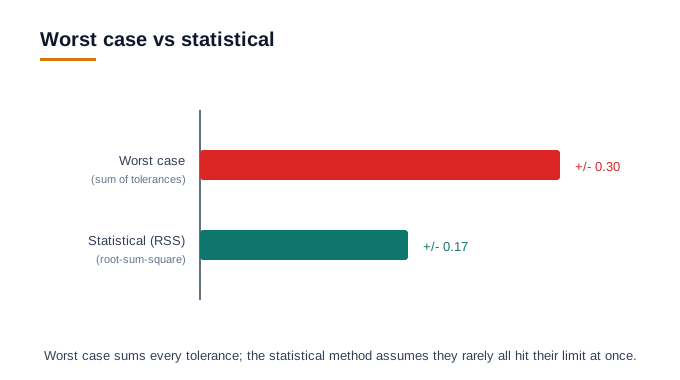
Worst-case stacking assumes every part hits its limit in the same direction at once, which is safe but pessimistic. The statistical method (root-sum-square, RSS) recognizes that parts vary randomly and rarely all reach their extremes together, so it combines tolerances as the square root of the sum of their squares. For the three +/- 0.10 mm features above, RSS gives about +/- 0.17 mm (0.007 in) instead of +/- 0.30 mm. Use worst case for safety-critical fits and low part counts, and the statistical method for higher volumes where the extremes are genuinely unlikely.
Designing the stack down
The best way to win a stack-up is to shorten the chain:
- Reduce part count. Every part in the chain adds its tolerance. Combining features into fewer parts removes links directly.
- Share datums. Referencing mating features to the same datum, rather than chaining dimension to dimension, stops tolerances from accumulating along the chain.
- Locate, do not chain. Dimension critical features from a single origin (baseline dimensioning) instead of point to point, so each feature's tolerance is independent rather than additive.
- Put the tight tolerance where it matters. Spend the tight band on the one or two features that drive the fit, and leave the rest loose, rather than tightening everything.
- Design in adjustment. A slot, a shim, or a compliant feature absorbs stack-up so the parts do not have to be perfect.
Assembly and fits
Where parts must fit together, specify the fit with the ISO 286 system (clearance, transition, or interference) rather than a raw dimension, so the assembly behavior is unambiguous. Give press-fit and locating features the datums they need to be measured against, and tell us the critical assembled dimension so it can be verified.
The checklist
- The critical assembled dimension identified and its stack-up understood.
- Datums shared across mating features, not chained.
- Tight tolerances spent only on the features that drive the fit.
- Adjustment designed in where a stack cannot be tightened enough.
- Fits called out with the standard ISO 286 notation.
How MASA FabWorks helps
Our DFM engine checks each feature's tolerance against what the process can hold, so you know early whether the tolerances your stack needs are achievable, or whether the design should be changed to relax the chain. Each band is grounded in the tolerance standards behind it. The result is an assembly designed to go together, not one that only works if every part comes back perfect.
Frequently asked questions
- What is tolerance stack-up?
- It is how the tolerances of several parts add up across an assembly. Three parts each held to +/- 0.10 mm (0.004 in) in a line can leave a gap that varies by +/- 0.30 mm (0.012 in), because in the worst case every part sits at the same extreme.
- What is the difference between worst-case and statistical (RSS) stack-up?
- Worst-case stacking assumes every part hits its limit in the same direction at once, which is safe but pessimistic. The statistical root-sum-square method combines tolerances as the square root of the sum of their squares (about +/- 0.17 mm instead of +/- 0.30 mm for three +/- 0.10 mm features). Use worst case for safety-critical, low-count assemblies and RSS for higher volumes.
- How do I reduce tolerance stack-up?
- Shorten the chain: reduce part count, reference mating features to a shared datum instead of chaining dimension to dimension, spend the tight tolerance only on the features that drive the fit, and design in adjustment (a slot, shim, or compliant feature) where a stack cannot be tightened enough.
Related guides
Ready to check your own design? Upload your files. We measure your model against per-process, per-material rules and send a DFM review before you commit to a quote.