
How to Choose a Manufacturing Process
How material, volume, tolerance, and geometry point to CNC, sheet metal, 3D printing, vacuum casting, injection molding, or die casting, with a quick decision path.
Download PDFFour attributes pick a process: material, volume, tolerance, and geometry. Metal points to CNC, sheet metal, or die casting; plastic to injection molding, 3D printing, or vacuum casting. Low volume favors no-tooling processes (CNC, printing); high volume justifies a mold or die. Start with material and volume to shortlist, then let tolerance and geometry decide.
The single biggest cost-and-quality decision on a part is made before any design rule: which process makes it. The same bracket can be machined, molded, cast, printed, or folded from sheet, and each gives a different cost curve, tolerance, finish, and lead time. This guide is a short map from what you know about a part to the process that fits.
The trade-offs below draw on standard design-for-manufacture practice (Boothroyd DFMA) and on the capability of the processes we run. For the design rules within each process, see its dedicated guide.
The four questions
Four attributes decide most cases: material, volume, tolerance, and geometry.
1. Material
Metal or plastic is the first fork. Metals go to CNC machining, sheet metal, or die casting; plastics go to injection molding, 3D printing, or vacuum casting. A few processes cross over (CNC and 3D printing run both), but material narrows the field immediately.
2. Volume
Volume decides whether to pay for a tool.
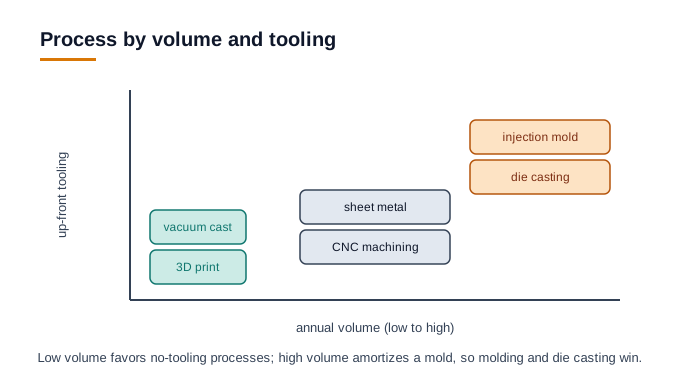
- Low volume (ones to hundreds): use a process with no dedicated tooling. 3D printing and vacuum casting for plastics, CNC and sheet metal for metals. You pay per part but nothing up front.
- High volume (thousands and up): pay once for a mold or die and the per-part cost drops far below any no-tooling process. Injection molding for plastics, die casting for metals.
Vacuum casting bridges the two: a soft silicone tool made from a printed master gives up to about 25 cast-plastic parts without hard tooling.
3. Tolerance and finish
If the part needs tight tolerances or specific finishes, machining holds the tightest bands and any finish; molding and casting hold looser as-formed tolerances and are machined only where a feature is critical; 3D printing is the loosest and is best for form, fit, and function checks rather than precision fits.
4. Geometry
Some shapes favor a process. Prismatic metal parts with pockets and holes machine well; thin-walled enclosures mold or cast well; flat parts with bends are sheet metal; organic or internal-channel shapes that no tool can reach are where 3D printing wins outright.
A quick decision path
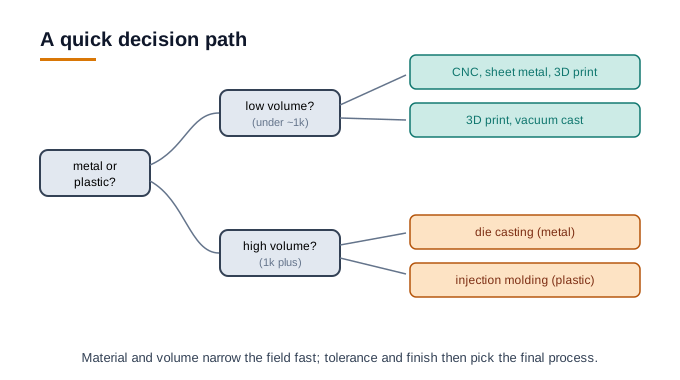
Start with material and volume to get to a shortlist, then let tolerance, finish, and geometry pick the final process. When more than one fits, the cheaper-at-your-volume option usually wins.
A rough comparison
| Process | Best volume | Tolerance | Tooling |
|---|---|---|---|
| CNC machining | 1 to thousands | Tightest | None |
| Sheet metal | 1 to thousands | Good | Low |
| 3D printing | 1 to hundreds | Loosest | None |
| Vacuum casting | about 10 to 25 | Moderate | Soft (silicone) |
| Injection molding | Thousands and up | Good (resin-dependent) | Hard (steel) |
| Die casting | Thousands and up | Good | Hard (steel) |
How MASA FabWorks helps
Upload a model and our DFM engine reads the geometry and, together with the material and volume you give, checks it against each offered process, so a part that will not mold cleanly or cannot be machined as drawn is flagged before you commit. If a different process suits the part better, that shows up early, when changing it is free. The result is the right process chosen for the part, not defaulted to.
Frequently asked questions
- How do I choose a manufacturing process?
- Answer four questions: what material, what volume, what tolerance, and what geometry. Material and volume narrow the field to a shortlist (no-tooling processes for low volume, molds and dies for high), then tolerance, finish, and geometry pick the final process.
- CNC machining or injection molding, which is cheaper?
- It depends on volume. CNC has no tooling cost but a flatter per-part curve, so it wins at low volume; injection molding carries a large up-front tool cost but a low per-part cost, so it wins above a crossover volume of thousands. Match the process to your real volume.
- When should I use 3D printing instead of molding?
- Use 3D printing for low volumes (ones to hundreds), for form-fit-function checks, and for organic or internal-channel shapes no tool can reach. Move to injection molding once volume reaches the thousands, where a hard tool drops the per-part cost far below printing.
Related guides
Ready to check your own design? Upload your files. We measure your model against per-process, per-material rules and send a DFM review before you commit to a quote.