
Designing for Die Casting: A DFM Guide
Wall thickness, draft, fillets, ribs, bosses, parting lines, and tolerances for aluminum, zinc, and magnesium die castings, with the numbers we use.
Download PDFDie casting wants thin, uniform walls that freeze soundly: about 1.0 mm (0.040 in) for zinc and 2.0 to 2.5 mm (0.080 to 0.100 in) for aluminum. Add 1 to 3 degrees of draft to every face along the die-open direction, fillet every internal corner, and design undercuts out so the die needs no slide.
Die casting injects molten metal under high pressure into a hardened steel die, producing hundreds of thousands of near-net-shape parts from one tool. Because the tool is expensive and long-lived, the design work is front-loaded: a wall that traps gas, a boss without a fillet, or an undercut that forces a slide is a defect or a cost that repeats on every shot. Get the geometry right and the die is simpler, the casting is sound, and the parts are consistent.
This guide covers the rules that most affect a die-cast part, with the numbers we use, keyed to alloy where it matters. Each is the same check the MASA FabWorks DFM engine runs before you quote, grounded in the NADCA product specification standards, the ASTM die-casting specifications, and ISO 8062-3 for cast tolerances.
Alloys
We cast the three common die-casting families:
| Family | Grades | Character |
|---|---|---|
| Aluminum | A380, A383, A360, A413 | Light, strong, good thermal conductivity, most common |
| Zinc | Zamak 3, Zamak 5 | Casts the thinnest walls, lowest temperature, excellent detail |
| Magnesium | AZ91D, AM60B | Lightest structural metal, thin walls, good stiffness-to-weight |
Wall thickness
Die-cast walls should be thin and uniform. Metal freezes fast against the cold die, so a thin wall fills and solidifies soundly, while a thick section stays molten inside and traps shrinkage porosity. Zinc, which fills at lower temperature, holds the thinnest walls; magnesium and aluminum need a little more.
| Alloy | Recommended wall | Minimum |
|---|---|---|
| Zinc | 1.0 mm (0.040 in) | 0.5 mm (0.020 in) |
| Aluminum | 2.0 to 2.5 mm (0.080 to 0.100 in) | 1.5 mm (0.060 in) |
| Magnesium | 2.0 mm (0.080 in) | 1.5 mm (0.060 in) |
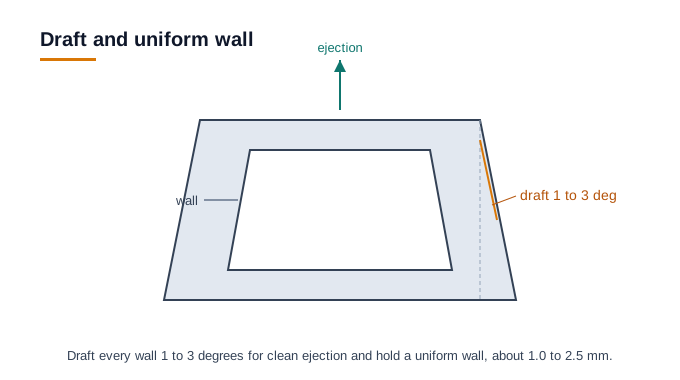
Hold the wall uniform. Where a heavy section is unavoidable, core it out rather than leaving a solid mass that will shrink internally.
Draft
Every face parallel to the direction the die opens needs draft, or the casting drags on the steel and scuffs or sticks. Die casting needs a degree or two, more on deep or textured walls.
Recommended draft is about 1 to 3 degrees on outside walls, with more on inside walls and cores, since the casting shrinks onto them as it cools. Add draft early; it is nearly free at the design stage and costly to cut into a finished die.
Fillets, ribs, and bosses
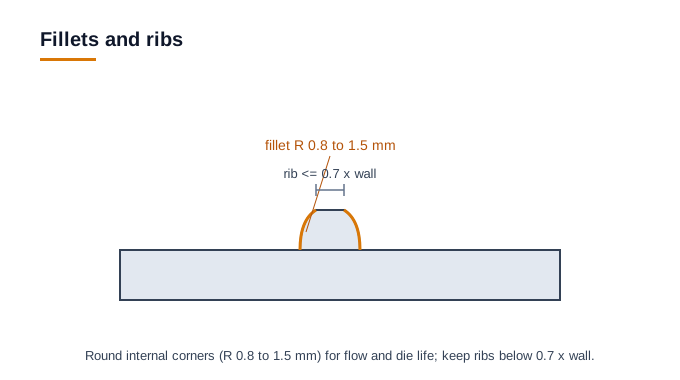
- Round every internal corner. A sharp corner concentrates stress, disrupts metal flow, and cracks the die over time. Use a fillet of about 0.8 to 1.5 mm (0.030 to 0.060 in).
- Ribs stiffen a wall without thickening it. Keep a rib at or below about 70 percent of the wall it joins, so it does not pull a sink on the show face, and blend it with fillets.
- Connect bosses to a wall or rib with a gusset, and keep the boss wall proportioned to the wall rather than left as a thick stub.
Parting line and side actions
The die opens on a parting line, so place it on a simple plane where the two halves separate cleanly.
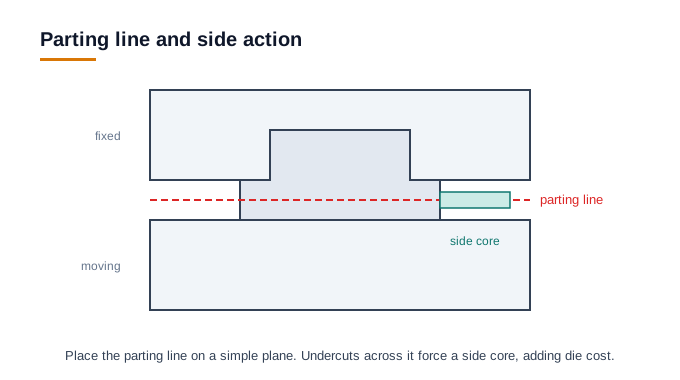
A feature that undercuts the parting direction, a side hole, a snap, an external groove, cannot release when the die opens and forces a slider or side core, which adds die cost and cycle time. Design undercuts out where you can, and flag the ones the part needs so the die is quoted correctly.
Tolerances and finishing
As-cast tolerances follow the NADCA standards and ISO 8062-3 and depend on dimension and alloy, roughly +/- 0.1 to 0.2 mm (0.004 to 0.008 in) on small features, with tighter bands achievable on machined features. Call out a tight tolerance only where a part mates or seals, and plan to machine those faces after casting. Finishes range from as-cast through machined, polished, and textured, with a light draft increase needed on textured faces.
The DFM checklist
Before you send a model to quote, confirm:
- Wall thin and uniform for the alloy, heavy sections cored out.
- Draft on every face that parallels the die-open direction.
- Internal corners filleted, ribs at or below 70 percent of wall.
- Bosses connected and proportioned, not left as thick stubs.
- Parting line on a simple plane, undercuts removed or flagged for slides.
- Tight tolerances only on mating or sealing features, planned as post-machining.
How MASA FabWorks checks this for you
When you upload a model, our DFM engine measures wall thickness and uniformity, checks draft against the die-open direction, evaluates fillets, ribs, and bosses, and detects undercuts that force side actions, per alloy, before you quote. It tells you where a wall will trap porosity, where a corner needs a fillet, or where an undercut will drive tool cost, and why. Each result is grounded in the casting standard behind it. The outcome is a casting designed to fill soundly and a tool that runs.
Frequently asked questions
- What wall thickness should a die casting use?
- Keep walls thin and uniform: about 1.0 mm (0.040 in) for zinc, which fills at low temperature, and 2.0 to 2.5 mm (0.080 to 0.100 in) for aluminum and magnesium. A thick section stays molten inside and traps shrinkage porosity, so core out heavy masses.
- Which die-casting alloy should I use?
- Aluminum (A380 and family) is the light, strong all-rounder; zinc (Zamak 3 and 5) casts the thinnest walls and finest detail at low temperature; magnesium (AZ91D, AM60B) is the lightest structural metal. Choose by weight, detail, and strength.
- What tolerance can die casting hold?
- As-cast features run roughly +/- 0.1 to 0.2 mm (0.004 to 0.008 in) per the NADCA and ISO 8062-3 standards, depending on size and alloy. Machine the faces that mate or seal after casting, and leave the rest as-cast.
Related guides
Ready to check your own design? Upload your files. We measure your model against per-process, per-material rules and send a DFM review before you commit to a quote.