
Designing for Vacuum Casting: A DFM Guide
How urethane casting works and the wall, draft, undercut, tolerance, and resin rules for realistic cast-plastic prototypes from a silicone mold.
Download PDFVacuum casting pours polyurethane into a silicone mold made from a 3D-printed or machined master, yielding up to about 25 realistic cast-plastic parts with no hard tooling. Keep walls at or above 1.5 mm (0.060 in), use about 1 degree of draft, and expect around +/- 0.3 mm (0.012 in) accuracy, so it suits low-volume prototypes, not production.
Vacuum casting, also called urethane or silicone-mold casting, makes a small run of parts by pouring liquid polyurethane into a silicone mold under vacuum. The mold is cast around a master pattern, usually a 3D print or a machined part, so the process bridges the gap between one-off prototypes and hard tooling: it produces dozens of realistic, cast-plastic parts without the cost and lead time of a steel injection mold.
This guide covers the design rules that matter for vacuum-cast parts, with the numbers we use. Each is the same check the MASA FabWorks DFM engine applies before you quote. Because the tool is soft silicone rather than steel, several rules are more forgiving than injection molding, but a few, tolerance and durability, are looser, and the guide flags both.
How it works
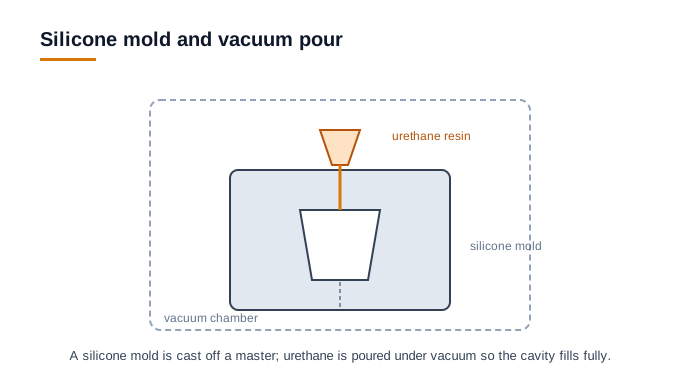
A master pattern is finished to the surface you want, then a two-part silicone mold is cast around it. Liquid polyurethane is mixed, colored, and poured into the mold inside a vacuum chamber so trapped air is drawn out and the resin fills every detail. After curing, the mold is opened and reused. A silicone mold yields a limited number of copies, on the order of a couple of dozen, before it wears, so vacuum casting suits low-volume runs rather than ongoing production.
Materials
The polyurethane resins are formulated to emulate common thermoplastics:
| Resin class | Emulates | Typical use |
|---|---|---|
| Rigid ABS-like | ABS | General enclosures, housings |
| Rigid PC-like | Polycarbonate | Tougher, higher-heat parts |
| Glass-clear | PMMA / clear PC | Lenses, light pipes, transparent covers |
| Rubber-like | TPE / rubber (Shore A 30 to 90) | Seals, grips, over-molds |
Rigid grades run about Shore 80 D; rubber grades are specified by Shore A hardness. Color can be cast in or the part painted afterward.
Wall thickness and draft
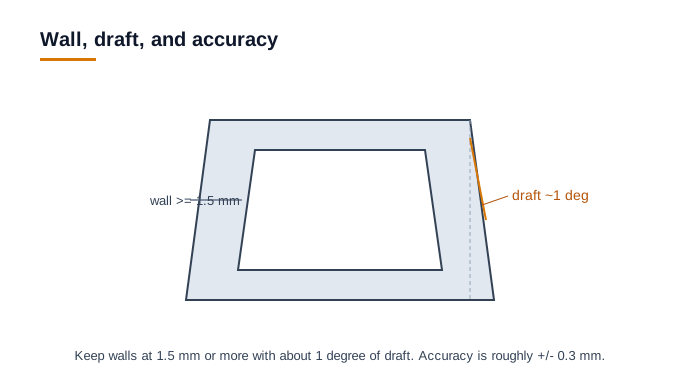
Keep walls at or above 1.5 mm (0.060 in); thinner walls risk incomplete fill even under vacuum. As with injection molding, hold the wall uniform and core out heavy sections, since a thick mass still sinks and can trap bubbles as it cures.
The soft mold flexes on release, so vacuum casting needs less draft than steel tooling, about 1 degree is usually enough, and shallow undercuts can often be pulled directly from the silicone without a side action. Flag deeper undercuts so we can plan the mold split.
Tolerances and finish
Vacuum-cast accuracy is looser than machining or injection molding and depends on part size and geometry, typically around +/- 0.3 mm (0.012 in) on a small feature, with larger parts accumulating more. The resin also shrinks slightly as it cures. Call out only the dimensions that matter, and expect a fit-and-function prototype rather than a precision component.
Surface finish copies the master and the mold exactly, so a smooth, painted master gives a smooth part and a textured master carries its texture through. Finishes include as-cast, smooth, textured, and painted.
The DFM checklist
Before you send a model to quote, confirm:
- A clean master pattern finished to the target surface.
- Walls at or above 1.5 mm (0.060 in), held uniform, heavy sections cored out.
- About 1 degree of draft, deep undercuts flagged for the mold split.
- The right resin class chosen for stiffness, clarity, or rubber feel.
- Tolerances called out only where needed, with about +/- 0.3 mm (0.012 in) expected.
- Run size matched to the process, a couple of dozen parts per mold.
How MASA FabWorks checks this for you
When you upload a model, our DFM engine checks wall thickness and uniformity, draft, undercuts, and sink risk against the vacuum-casting process and the resin you choose, before you quote. It flags a wall too thin to fill, a thick mass that will sink, or an undercut that complicates the mold, and explains the fix. Each result is grounded in the casting design reference behind it. The outcome is a set of realistic cast-plastic parts that come out clean and consistent.
Frequently asked questions
- What is vacuum casting used for?
- It makes a small run, up to about a couple of dozen parts, of realistic cast-plastic prototypes from a silicone mold poured under vacuum. It bridges the gap between one-off 3D prints and hard injection tooling, without the cost or lead time of a steel mold.
- How accurate is vacuum casting?
- Expect around +/- 0.3 mm (0.012 in) on a small feature, looser than machining or injection molding, with larger parts accumulating more and the resin shrinking slightly as it cures. Treat it as a fit-and-function prototype, not a precision component.
- How many parts can one silicone mold produce?
- On the order of a couple of dozen (up to about 25) before the soft mold wears, which is why vacuum casting suits low-volume runs rather than ongoing production.
Related guides
Ready to check your own design? Upload your files. We measure your model against per-process, per-material rules and send a DFM review before you commit to a quote.