
Threads, Inserts, and Fastening
Cut threads vs thread-milling, minimum thread engagement, and when to use heat-set, press-fit, or self-clinching inserts so a joint holds and survives reassembly.
Download PDFA thread holds only as deep as it engages: about 1 thread diameter in steel and 1.5 to 2 diameters in aluminum, brass, or plastic. Below that, or for repeated assembly, use an insert: heat-set in plastic, self-clinching in thin sheet. Use standard thread sizes, and thread-mill large or hard-material threads.
Threads and fasteners are where parts come together, and they are a common source of avoidable failure: a thread stripped because it was too shallow, a tapped hole cracked in a soft plastic, or a fastener that works loose because the material could not hold it. This guide covers how to add threads and inserts that hold, across the materials and processes we run.
Thread and hole sizing follow published standards: the ANSI/ASME B94.11M twist-drill series for tap drills, ISO 261 and ISO 965 for metric thread dimensions and tolerances, and Machinery's Handbook for engagement and tapping practice. The screening rules below are the ones that most affect whether a thread holds.
Cut threads: tap or thread-mill
A thread can be cut two ways. Tapping runs a dedicated tap of one size and pitch into a drilled hole; it is fast and standard for common sizes. Thread-milling uses a single small cutter to interpolate any diameter and pitch, reaches close to the bottom of a blind hole, and does not risk a broken tap stuck in the part, so it is preferred for large threads, hard materials, and blind holes.
Either way, a thread starts as a drilled hole at the tap-drill diameter (roughly the thread minor diameter). Use standard thread sizes wherever the design allows: a standard size uses a stock tap or a standard mill pass, while an off-standard thread forces a custom setup.
Thread engagement
A thread holds only as deeply as it engages. Too little engagement strips before the fastener reaches its rated load; more than enough wastes depth and cost.
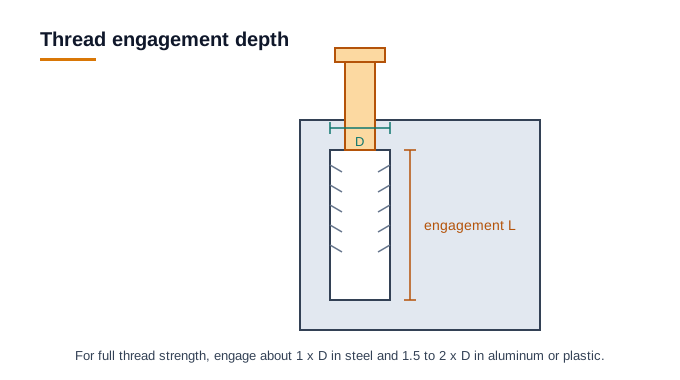
As a rule of thumb, engage a length of about 1 times the thread diameter in steel, and 1.5 to 2 times the diameter in aluminum, brass, or plastic, since the softer the material the more thread it takes to reach full strength. Below those depths, plan for an insert.
When to use an insert
If the base material is too soft, too thin, or too abrasive to tap reliably, or the joint will be assembled and disassembled repeatedly, use a threaded insert. Inserts put a hard steel or brass thread into a softer body.
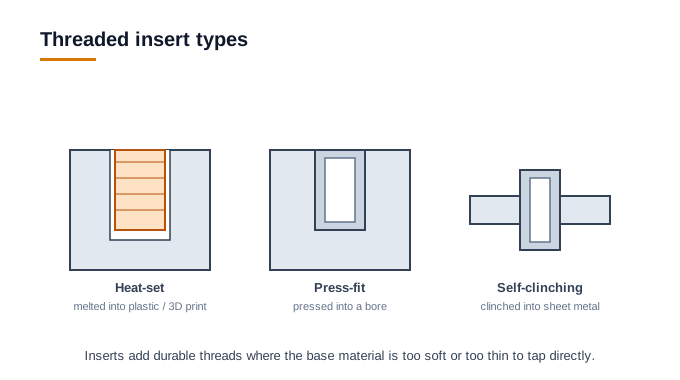
- Heat-set inserts are pressed into a molded or 3D-printed plastic boss with a hot tip that melts the plastic around the knurl. They are the standard for repeated assembly in plastic parts.
- Press-fit and threaded inserts seat into a machined bore, adding a durable thread to a metal or plastic part.
- Self-clinching (clinch) inserts are pressed into sheet metal, which is usually too thin to tap. Thin sheet has too little thickness to tap directly (the limit depends on the thread size), so clinch hardware is the default there.
Design the boss or hole to the insert manufacturer's recommended size, and give a plastic boss enough wall around the insert so it does not split.
Tapped holes: practical rules
- Give a blind tapped hole a little clearance below the last thread so the tap does not bottom out; thread-milling needs less.
- Keep a tapped hole far enough from an edge or a thin wall that tapping does not blow out the side.
- On a through hole, a chamfer at the entry helps the fastener start straight.
- For a cosmetic or sealing face, keep threads away from it, since the tap can leave a burr.
Clearance holes and countersinks
A fastener that passes through a part rather than threading into it needs a clearance hole, sized a little over the fastener shank per the standard clearance-fit tables (close, normal, or loose). Countersinks for flat-head screws follow the fastener's included angle (commonly 82 degrees for inch, 90 degrees for metric); call out the angle so the head sits flush.
The checklist
Before you send a model to quote, confirm:
- Standard thread sizes wherever possible; large or hard-material threads flagged for thread-milling.
- Engagement of about 1 x D in steel, 1.5 to 2 x D in aluminum or plastic, or an insert planned.
- Inserts specified where the material is soft, thin, or reused: heat-set in plastic, clinch in sheet.
- Blind tapped holes given clearance below the thread; holes kept clear of edges and thin walls.
- Clearance holes and countersink angles called out for pass-through fasteners.
How MASA FabWorks checks this for you
When you upload a model, our DFM engine checks holes and threaded features against the process and material, before you quote. On sheet metal it flags threads in stock too thin to tap and points to clinch hardware; on machined and molded parts it checks hole sizes and proximity. Each result is grounded in the thread and tooling standards behind it, so the guidance is traceable. The outcome is a joint that holds the first time and every time it is reassembled.
Frequently asked questions
- How deep should a thread engage?
- Engage about 1 times the thread diameter in steel and 1.5 to 2 times the diameter in aluminum, brass, or plastic, since softer materials need more thread to reach full strength. Below those depths, plan for a threaded insert.
- When should I use a threaded insert?
- Use one when the base material is too soft, thin, or abrasive to tap reliably, or when the joint is assembled and disassembled repeatedly. Heat-set inserts suit molded and printed plastic; self-clinching inserts suit sheet metal, which is usually too thin to tap.
- Can you tap threads directly into sheet metal?
- Thin sheet has too little thread engagement to tap reliably (the limit depends on the thread size), so cycled fasteners use self-clinching (clinch) inserts pressed into the sheet and sized to the hole per the insert standard.
Related guides
Ready to check your own design? Upload your files. We measure your model against per-process, per-material rules and send a DFM review before you commit to a quote.